
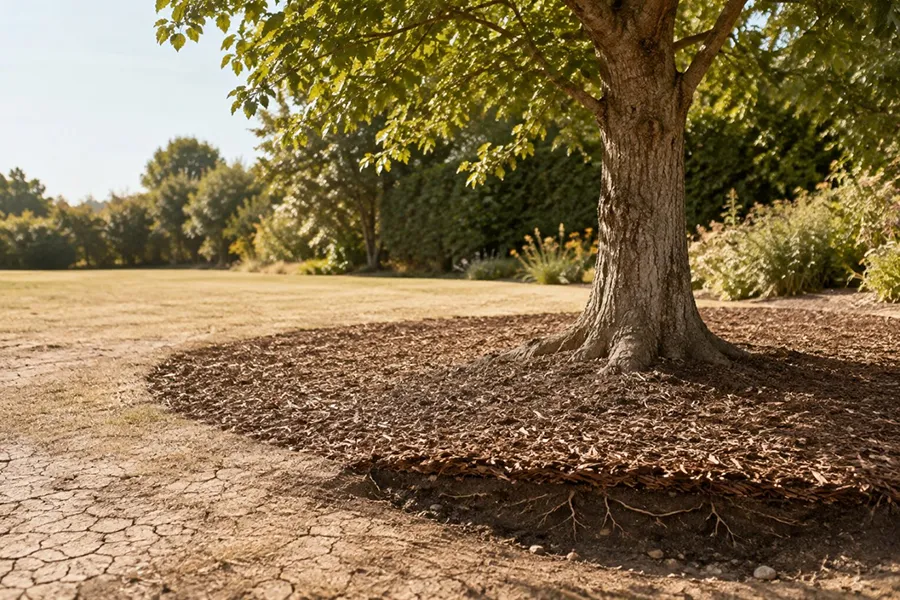
Long periods of hot, dry weather can place trees under pressure when the soil has dried below the surface. Reduced moisture can limit water uptake, slow growth and contribute to leaf scorch, early leaf fall or dieback. Forest Research warns that repeated drought can have cumulative effects, especially on shallow or freely draining soils.
A useful response is to care for the ground around the tree. Correct mulching, combined with sensible watering, can help retain moisture and give roots a more stable environment. It cannot make a structurally unsafe tree stable, but it can help a mildly stressed tree cope better with dry conditions.
How dry ground affects trees
Trees lose water through their leaves and replace it through their roots. During prolonged heat, the soil may dry faster than the roots can replenish that moisture.
Newly planted trees are especially vulnerable because their roots have not yet spread far into the surrounding ground. The RHS advises that drought stress is common during the first few years after planting, even when the surface does not look particularly dry.
Possible signs include wilting or curling leaves, brown edges, unusually small leaves, sparse foliage and early leaf fall. These symptoms are not a diagnosis by themselves. Waterlogging, damaged roots, compaction, pests and disease can look similar, so check the soil below the surface before adding water.
Browns has more guidance on recognising signs of tree dieback.
Why mulch helps
Mulch forms a protective layer over the soil. It reduces evaporation, suppresses grass and weeds competing for water, and moderates soil temperature. Organic materials such as composted woodchip, bark and leaf mould gradually break down and can support soil structure.
This is particularly helpful around trees growing in lawns. Removing a circle of turf and replacing it with mulch gives the roots less competition and reduces the risk of mower or strimmer damage.
Mulch does not create water. If the ground is extremely dry, water it slowly first, allow the moisture to soak in, then apply mulch to reduce further loss.
How to mulch a tree correctly
Aim for a flat, even layer around 5 to 8cm deep. Guidance commonly places the useful range between 5 and 10cm, but 10cm is an upper limit rather than a target. Excessively deep mulch can restrict air movement and retain too much moisture.
Extend the mulch over as much of the rooting area as space allows. For a young tree, a circle at least 1 to 1.2 metres across is a useful starting point. A broad area is more helpful than a small ring immediately around the trunk.
Most importantly, leave a clear gap around the trunk and visible root flare, where the trunk widens into the main roots. Keep mulch roughly 10cm away from young stems and further away where necessary on larger trees. Never build a cone or “volcano” against the bark. Constant moisture around the stem can soften the tissue and increase the risk of disease or decay.
In borders and planted beds, spread mulch as a level layer across open soil rather than making individual piles. Leave space around tree trunks, shrub stems and the crowns of smaller plants.
Water deeply, not little and often
When watering is needed, a slow, thorough soak is generally more useful than a small daily splash. Apply water to the soil across the root zone. Early morning is usually best because less water is lost through evaporation.
The amount and frequency will depend on the tree’s age, size, species, soil and recent rainfall. Young trees may need regular support during dry spells, while established trees should not be watered automatically.
Check several centimetres below the surface first. If the soil is still cool and damp, wait.
Avoid flooding the surface, which can cause run-off without wetting deeper soil. Take particular care on compacted clay or poorly drained ground. Too much water excludes air from the soil and can produce symptoms similar to drought stress.
When dry ground is not the only problem
Mulching is tree care, not structural repair. A tree that has developed a fresh lean, cracked or lifting soil around its base, exposed roots, large hanging branches or extensive crown dieback should be professionally assessed.
For mature trees, Browns provides specialist veteran tree care. Property and facilities managers can arrange tree surveys and reports. Where pruning or reduction may be appropriate, read about our tree pruning, reduction and removal services.
If a tree is leaning dangerously or a branch is at immediate risk of falling, use our emergency tree call-out service.
Give the roots a better chance
During hot weather, it is easy to focus on the canopy. Often, the most useful action is at ground level. A broad, correctly applied layer of mulch, kept clear of the trunk, can reduce moisture loss and competition while protecting the rooting environment.
If you are unsure whether a tree is simply drought-stressed or showing a more serious problem, contact Browns Tree Solutions for practical advice and an assessment.
Frequently asked questions
How thick should mulch be around a tree?
A layer of around 5 to 8cm is suitable for most garden situations. Avoid exceeding 10cm, as very deep mulch can hold excessive moisture and affect airflow into the soil.
Should mulch touch the tree trunk?
No. Leave a gap of roughly 10cm around a young tree’s trunk and keep the root flare visible. Mulch touching the bark can retain moisture and make the stem more vulnerable to disease.
How often should I water a tree during hot weather?
There is no universal timetable. Check the soil below the surface and water slowly and thoroughly when it is becoming dry. Young or recently planted trees normally need more attention than established trees.
Can too much mulch damage a tree?
Yes. Deep mulch or mulch piled against the trunk can retain too much moisture, reduce airflow and encourage stem or root problems.
How can I tell whether a dry tree is dying?
Wilting, scorched leaves and early leaf fall can indicate drought stress, but they do not prove that a tree is dying. Extensive dieback, large dead branches, exposed roots or movement at the base should be assessed by an arborist.
Trusted sources and further guidance
Royal Horticultural Society, Mulches and Mulching. Mulches and Mulching | RHS Advice
Royal Horticultural Society, Watering Plants Wisely. Watering Plants Wisely | RHS Advice
Royal Horticultural Society, Trees and Shrubs: Planting Guide. https://www.rhs.org.uk/plants/types/trees/planting-trees-shrubs
Forest Research, Drought. Drought - Forest Research
Forest Research, Urban Forests. Urban Forests - Forest Research
Forestry Commission, How to Help Young Trees Survive Prolonged Hot, Dry Weather. How to help young trees survive prolonged hot dry weather – Forestry Commission
Woodland Trust, Common Symptoms of Tree Pests and Diseases. Key tree pests and diseases - Woodland Trust